Cash bribes buy passage for telecom scammers at Myanmar junta checkpoints
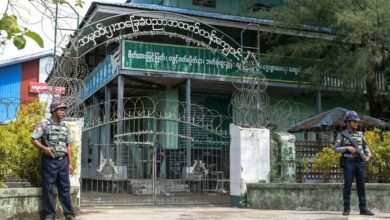
Myanmar junta troops at checkpoints in southeastern Mon and Karen states are collecting hefty bribes in Thai baht to allow telecom scam operators—locally known by the Mandarin term zhapian (fraud)—to travel freely through the region, according to local transport and vehicle rental sources.

Security personnel along major transit routes—connecting Mon State’s capital, Mawlamyine, to Mudon, and Karen State’s capital, Hpa-An, to border hubs such as Myawaddy, Shwe Kokko and Payathonzu—reportedly demand between 10,000 and 100,000 Thai baht (roughly $290 to $2,900) per vehicle carrying foreign nationals and Myanmar citizens linked to the scam syndicates.
“We sometimes have to pick up zhapian operators in Yangon or at the Thanlwin Bridge in Hpa-An. For foreigners coming in from the Thai side, we usually take them to Myawaddy and Payathonzu,” said a driver who previously transported scam personnel.
“Junta checkpoints typically charge between 10,000 and 100,000 baht for each vehicle to pass through. They charge even more when foreigners are on board.”
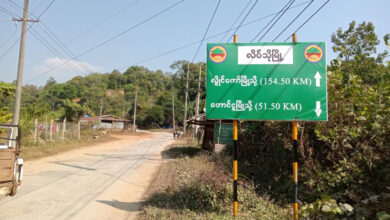
Vehicles traveling through the two states must pass through a dense network of military checkpoints—including at Gyaing, Zarthapyin, Mottama and the Thanlwin Bridge near Mawlamyine, as well as Koetaing, Kyondoe, Kalagon, Kyainseikgyi and Kyaikmayaw—where troops routinely wave scam-linked vehicles through once the fees are paid.
Collected bribes are typically divided among junta soldiers and staff from various government departments stationed at the checkpoints, sources from local armed groups said.
“I transported Chinese nationals from Shwe Kokko to [Myanmar’s major cities of] Yangon and Mandalay,” said a member of a local armed group who previously ferried people involved in the scam operations.
“We had to pay money at checkpoints along the way, and we also had to make advance payments to junta authorities.”
Meanwhile, numerous new telecom scam compounds have recently emerged along the Thai-Myanmar border, including in Payathonzu, Myawaddy, Shwe Kokko, Wawlay and Thitkatay, recruiting workers primarily through social media platforms.
“Zhapian businesses are recruiting new workers. They usually offer a basic salary of 20,000 baht [about $580], which can go up to 40,000 baht [$1,160] depending on a person’s skills, with free accommodation and meals,” said a Myawaddy resident who previously worked inside a scam compound.
“However, workers have to promise to stay inside and work for six straight months without going out. Supervisors also usually confiscate their national identity cards. People of all ages come here to work.”
The international community has sought to crack down on cross-border crimes along the Thai-Myanmar frontier by imposing sanctions, blacklists, and arrest warrants on key individuals and entities linked to the syndicates. In response, Myanmar’s military regime enacted an Online Fraud Prevention Law, ostensibly to combat cyber scams—a move widely viewed by critics as largely symbolic.
Despite those measures, the junta itself remains a central enabler, allowing telecom scam operations to take root and flourish in border areas, according to observers monitoring transnational crime in the region.