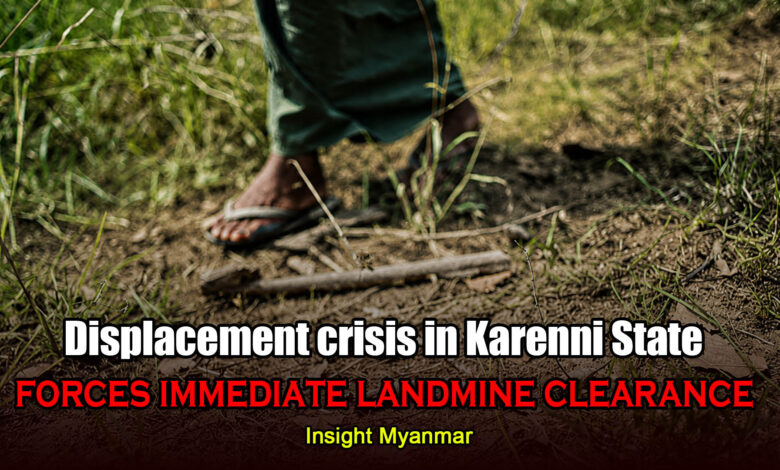
Displacement crisis in Karenni State forces immediate landmine clearance
Insight Myanmar
(7 Aug 2026)
The Karenni Interim Executive Council was founded in June 2023 based on bottom-up governance at the state level, with a view to an eventual federal democratic union. Amid the conflict, the IEC’s goals are to foster cooperation among different forces within Karenni State, deliver public services, and protect the public, including against the growing landmine threat.
In the past four years, at least 80 percent of the Karenni population has been displaced, according to the IEC. As people return to their homes, there is an immediate need to clear villages and fields of landmines and unexploded ordnance so they can resume their livelihoods, despite the danger of ad hoc demining and little international support.
“We cannot wait until the end of the war or end of the conflict, and then we will return to our country, return to our home. We need to return today,” IEC Secretary and human rights activist Banya Khung Aung recently told Insight Myanmar. “There are 1,000 landmines planted every day… We need to clean the land today. Sometimes we cannot adjust the process to the international standard, because we are so far from the international standard. We are in the war zone.”
As in many ethnic areas, there is a long history of the military using landmines in Karenni State, mainly planting them in border areas with Thailand, along electrical grid lines, and near army bases and the Lawpita hydropower project. Before the coup, there had only been one recorded landmine casualty since the bilateral agreement between the Karenni National Progressive Party (KNPP) and the Thein Sein government in 2013.
Landmine contamination since has greatly expanded. Demoso, Hpruso and Loikaw townships are among the worst affected, Banya Khung Aung said, adding that one military defector had reported that individual soldiers were ordered to plant 20 to 50 landmines per day. In a 2022 report, Amnesty International concluded that the military was laying mines around churches, homes, farms and other civilian properties in Karenni State, amounting to war crimes violating customary international humanitarian law.
In 2025, there were 143 civilians killed and 474 wounded, including 16 landmine incidents, according to the Karenni Human Rights Group, which Banya Khung Aung founded. The deaths and injuries inflicted by landmines are compounded by the psychological consequences, with the military-made M14 “Toe Popper” mine intended to inflict injuries, not kill the victim.
“You will never forget the experience of the loss of your body, so people will be forever blaming each other,” Banya Khung Aung said. “That’s why we need to have social reintegration for those people. Without integration, these people will forever stay in the dark mindset.”
Karenni armed groups are also planting landmines, including handmade improvised explosive devices and munitions captured from the military. In 2006, the KNPP filed a statement with the humanitarian organization Geneva Call concluding “the use of landmine is immoral, for they carry too high a risk” to civilians, but added that they were still used “as we lack alternative means of defence” against “an enemy that has no scruples”. The KNPP also expressed willingness to work with humanitarian mine action actors on education and clearance.
The IEC is conducting landmine awareness sessions and clearing some land for civilian returns, but lacks resources, including for victim assistance. Emergency response teams and Karenni armed groups carry out demining without detectors, forcing them to rely on dangerous methods using bamboo sticks or knives, tractors tilling land, or controlled fires that detonate the landmines or damage them.
There is little international support for these efforts, while very small investments could save many lives, according to Banya Khung Aung. He adds that international organizations should be learning from experience on the ground. “In a conflict area, there should be a new model,” he said. “This ground-level model can become another platform for the international standard.”